Serve friday: AI in Thailand and How It Compares in Asia
Serve friday: AI in Thailand and How It Compares in Asia
Date and Scope
Date: 2026-06-19
Scope: This report reviews whether Thailand is creating its own AI models, and how Thailand’s AI ecosystem compares with other Asian countries, using only the supplied sources. Key evidence comes from UNESCO’s Thailand AI readiness assessment (Source 1: https://www.unesco.org/en/articles/thailand-artificial-intelligence-readiness-assessment-report?hub=195885&utm_source=openai), SCB 10X’s Typhoon launch (Source 2: https://www.scb.co.th/en/about-us/news/jan-2024/scb-10x-typhoon.html), Mahidol University’s OpenThaiGPT 1.5 publication (Source 3: https://murex.mahidol.ac.th/en/publications/openthaigpt-15-a-thai-centric-open-source-large-language-model/), and OECD’s ASEAN AI review (Source 4: https://www.oecd.org/en/publications/digital-trade-review-of-the-association-of-southeast-asian-nations_abd6f44a-en/full-report/transitioning-asean-towards-the-ai-era_158513b0.html). NSTDA’s ThaiLLM announcement is also included as a supporting official source (Source 5: https://www.nstda.or.th/en/news/news-years-2026/thaillm.html).
Executive Summary
Thailand is clearly building domestic AI models, not just consuming foreign ones. The evidence shows at least three Thai model-building tracks: NSTDA’s ThaiLLM sovereign foundation model effort, SCB 10X’s Typhoon, and Mahidol University’s OpenThaiGPT 1.5 (Source 5; Source 2; Source 3). These models are Thai-focused, publicly accessible in different ways, and aimed at Thai language and local use cases.
Compared with other Asian countries, Thailand appears to be an emerging AI builder rather than a regional leader. OECD’s ASEAN analysis places Singapore as the regional AI leader, while Thailand is improving but still behind Malaysia, Singapore, and Viet Nam on policy maturity, patents, and talent depth (Source 4). UNESCO’s assessment also points to governance, coordination, and capacity gaps in Thailand’s AI ecosystem (Source 1). The overall picture is positive on model creation, but mixed on ecosystem readiness.
Key Findings
- Thailand does have domestic AI model creation activity across government, private sector, and academia (Source 5; Source 2; Source 3).
- ThaiLLM is a sovereign Thai foundation model with 8B and 30B variants, trained on over 100 billion Thai tokens and made publicly available through a playground, API, and downloads (Source 5).
- Typhoon is a Thai-optimized LLM released by SCB 10X, with an open-source 7B model and an API-based instruction-tuned version (Source 2).
- OpenThaiGPT 1.5 is a Thai-centric open-source model based on Qwen v2.5 and fine-tuned on over 2,000,000 Thai instruction pairs (Source 3).
- Thailand’s broader AI ecosystem is still maturing, with UNESCO identifying gaps in policy coherence, institutional coordination, and capacity development (Source 1).
- In regional comparison, Singapore leads ASEAN, and Thailand trails countries such as Malaysia and Viet Nam on some readiness indicators, including policy framework maturity, patents, and AI talent density (Source 4).
Detailed Findings
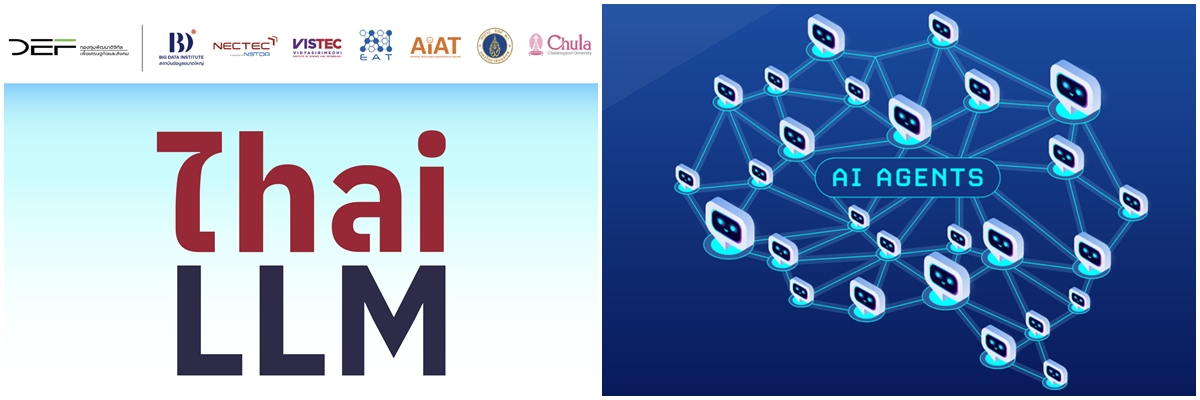
Thailand’s strongest signal is that it is now producing its own AI models. NSTDA says Thailand has launched ThaiLLM as a “home-grown AI infrastructure” designed for Thai language and culture, with 8B and 30B models, training on over 100 billion Thai tokens, and public access via playground, API, and model downloads (Source 5). That is a major indicator of sovereign model-building capacity.
The private sector has also contributed. SCB 10X introduced Typhoon in January 2024 as a Thai-optimized large language model. SCB describes the 7B pretrained model as open source and free to download under Apache 2.0, while an instruction-tuned version is available through an API (Source 2). This matters because it shows that model development in Thailand is not limited to state-led infrastructure.
Academia adds a third layer. Mahidol University’s OpenThaiGPT 1.5 is described as a Thai-centric open-source large language model based on Qwen v2.5 and fine-tuned on over 2,000,000 Thai instruction pairs (Source 3). The source says it supports multi-turn conversation, RAG compatibility, and tool-calling, and claims state-of-the-art performance among open-source Thai models (Source 3). That suggests a real research and engineering base for Thai-language model development.
At the ecosystem level, UNESCO’s Thailand AI readiness assessment shows that the country has formal AI governance attention, but not full maturity. The assessment was conducted with more than 30 institutions and identifies gaps in policy coherence, institutional coordination, and capacity development (Source 1). This means Thailand is building governance while also building models; the two are not yet fully aligned.
Source Analysis (Official vs. Secondary)
The official sources are especially important here because they directly document Thai model creation:
- NSTDA’s ThaiLLM launch is the strongest official evidence of a sovereign Thai foundation model effort (Source 5).
- SCB 10X’s Typhoon announcement is direct evidence of private-sector model development in Thailand (Source 2).
- Mahidol University’s OpenThaiGPT 1.5 publication is direct evidence of academic model development (Source 3).
UNESCO’s readiness assessment is also official, but it focuses on governance and ecosystem readiness rather than model creation itself (Source 1). It is valuable because it shows the institutional state of Thailand’s AI environment.
The OECD report is secondary, but it is the best source here for regional comparison. It provides the clearest cross-country framing for ASEAN AI readiness, including Thailand’s position relative to Singapore, Malaysia, and Viet Nam (Source 4).
Comparison / Synthesis
The best overall synthesis is that Thailand has crossed an important threshold: it is now an AI model-building country. It is not yet at the level of the strongest regional AI powers, but it has real domestic capability.
Compared with Singapore, Thailand is behind in ecosystem leadership. OECD calls Singapore a regional leader and global player, while Thailand is still in the group with advanced policy discussions but earlier implementation stages (Source 4). Singapore also leads in AI professional density, while Thailand is around 0.2 AI professionals per 1,000 workers compared with Singapore’s 3.5 per 1,000 workers (Source 4).
Compared with Malaysia and Viet Nam, Thailand is competitive in some investment areas but still trails in policy maturity and patents. OECD notes Malaysia, Singapore, and Viet Nam have the most developed domestic policy frameworks, and Thailand ranked 51st worldwide in granted AI patents per 100,000 inhabitants in 2023, behind Singapore, Malaysia, and Viet Nam in the cited comparison (Source 4).
The important nuance is that Thailand’s model-building activity is stronger than its overall ecosystem rank might suggest. In other words, Thailand can build models even while its governance, talent, and policy systems remain works in progress (Source 1; Source 4).
Practical Implications
- Thai businesses and agencies now have local model options that may better fit Thai language and context than generic global models (Source 5; Source 2; Source 3).
- Public access via playgrounds, APIs, and downloads suggests a pathway for experimentation, integration, and local adoption (Source 5; Source 2).
- Thailand’s governance gaps mean deployment should still be paired with careful oversight, especially for sensitive or public-sector use (Source 1).
- Regional competitiveness will depend not just on model launches, but on improving talent pipelines, policy coordination, and innovation output (Source 4).
Recommendations
- Treat Thailand as an emerging AI builder. The evidence supports active domestic model creation, so strategy should assume local capabilities are real (Source 5; Source 2; Source 3).
- Prioritize Thai-language deployment use cases. The strongest Thai models are optimized for Thai language and local workflows, so adoption should start there (Source 5; Source 2; Source 3).
- Pair model rollout with governance controls. UNESCO’s readiness gaps indicate that scaling AI should be matched with stronger coordination and capacity building (Source 1).
- Benchmark against Singapore, Malaysia, and Viet Nam. OECD shows those countries as useful reference points for policy maturity and ecosystem strength (Source 4).
- Expand talent development and open ecosystems. Thailand’s AI future depends on increasing AI professional density and sustaining open model development (Source 4; Source 3).
Conclusion
Thailand is building its own AI models in a meaningful way. ThaiLLM, Typhoon, and OpenThaiGPT 1.5 show that government, private sector, and academia are all contributing to Thai-language model development (Source 5; Source 2; Source 3). At the same time, Thailand’s broader AI ecosystem still trails the strongest ASEAN peers in readiness, talent, and governance maturity, especially Singapore (Source 4; Source 1). The most accurate conclusion is that Thailand is an emerging AI model-maker with real momentum, but not yet a regional leader in overall AI ecosystem strength.
Visual Sources







Source Table
Created with SonicMind Connect
Turn meetings, research and uploads into AI transcripts, summaries and shareable reports.
See the SonicMind showcaseNeed help solving a related problem?
Ask a question about this report or deck, request implementation help, or share a challenge you want the Qendryx team to look at.